Learning how to tell the time in Moroccan Darija is one of the most practical skills for beginners. Whether you’re traveling in Morocco, chatting with locals, or just trying to understand everyday conversations, time expressions come up constantly. From asking when the bus leaves to setting up a coffee with friends, knowing how to tell the time will help you feel confident and connected.
In this guide, we’ll walk step by step through the basics of telling time in Moroccan Arabic (Darija). We’ll cover hours, minutes, special phrases like “half past” and “quarter to,” and how Moroccans use time expressions in daily life. By the end, you’ll be able to ask and answer time questions naturally.
Why Learn to Tell the Time in Moroccan Darija?
In Morocco, time is part of daily conversation. You’ll hear people ask about the time in cafés, at bus stops, and even in casual chats on the street. If you can’t tell the time in Darija, you might rely too much on English or French, which can create distance.
Being able to say the time in Moroccan Darija shows respect for the culture and helps you connect. It also makes travel smoother: knowing when the train leaves, what time the shop opens, or when a friend is expecting you becomes much easier.
Asking for the Time in Moroccan Darija
The most common way to ask the time is:
- Sh7al f sa3a? (شحال ف الساعة؟) – What time is it?
You may also hear:
- Kam sa3a? – What’s the time?
- Chnu waqt daba? – What time is it now?
These expressions are widely understood. To sound natural, stick with Sh7al f sa3a? since it’s the most common.
Hours: The Foundation
To tell the time in Moroccan Darija, start with the hours. Morocco uses both 12-hour and 24-hour formats, depending on the context. In daily conversation, most people use the 12-hour clock with parts of the day for clarity.
Here’s how you say the hours in Darija:
- Wa7da – 1:00
- Jouj – 2:00
- Tlata – 3:00
- Rb3a – 4:00
- Khamsa – 5:00
- Setta – 6:00
- Sb3a – 7:00
- Tmenya – 8:00
- Ts3od – 9:00
- 3achra – 10:00
- 7dash – 11:00
- Tnash – 12:00
Example:
- Sh7al f sa3a?
- Hadi tlata nishan → It’s three o’clock. (You can add nishan which means = Sharp or O’clock)
We add the word Hadi to express time now: literally means : This is .
Adding Minutes

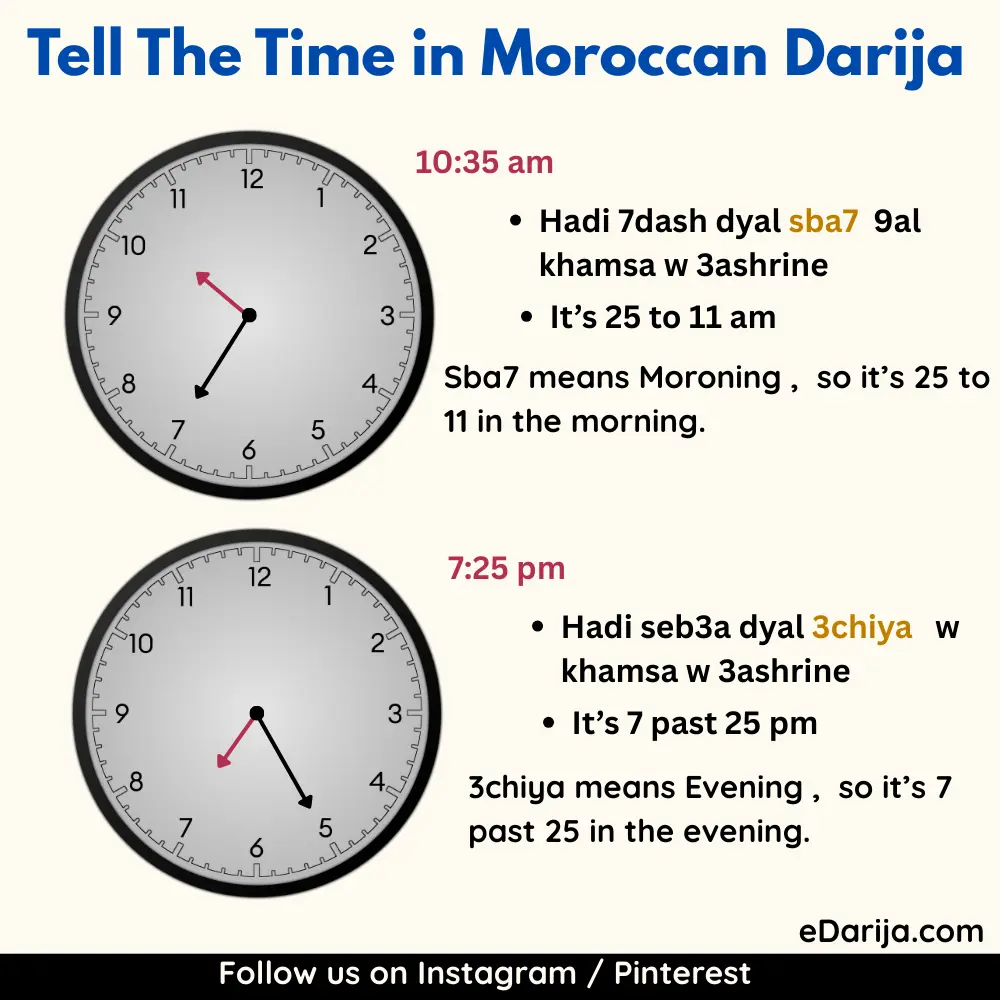
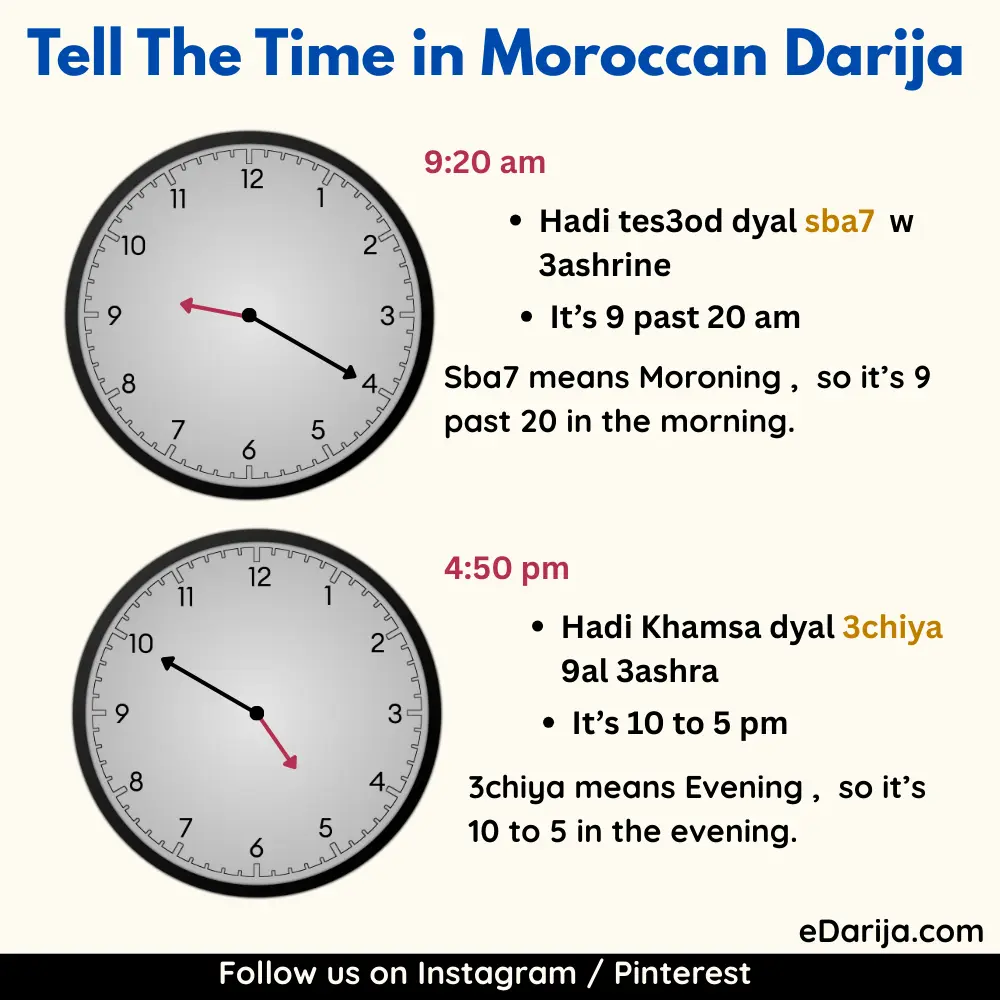
Just like in English, we add minutes to the hour. In Moroccan Darija, you simply say the hour followed by “and” plus the minutes.
- Wa7da w 10 = wa7da w 3ashra → 1:10
- Jouj w 20 = Jouj w 3ashrine → 2:20
- Tlata w 5 = Tlata w khamsa → 3:05
Example conversation:
- Sh7al f sa3a daba?
- Hadi rb3a w nos. → It’s four thirty. ( the word “Nos” means thirty or past half )
Discover Moroccan Darija for Beginners with our top-rated eBook!
Half Past, Quarter Past, Quarter To
Special phrases make telling the time in Moroccan Darija easier. These are very common:
- Nos (نص) → half past
- Rba3 (ربع) → quarter past
- 9al rba3 (إلى ربع) → quarter to
Examples:
- Setta w nos → 6:30
- Sb3a w rba3 → 7:15
- Tmenya 9al rba3 → 7:45
So, if a friend asks what time to meet, you might say:
- ntla9aw f sa3a tmenya 9al rba3. → Let’s meet at quarter to eight.
Using Parts of the Day
To avoid confusion, Moroccans often add parts of the day:
- F sba7 – in the morning
- Mor Lghda – Literally means after lunch and means = in the afternoon
- F l3chiya – in the evening
- F lil – at night
Examples:
- Hadi Tmenya dyal sba7. → It’s 8 in the morning.
- Hadi jouj dyal nhar ( nhar vs lil ) means ( Day vs night ) → It’s 2 pm.
- Hadi Tlata dyal lil → It’s 3 am.
- Hadi ts3od dyal 3chiya → It’s 9 in the evening.
Real-Life Examples
Let’s look at some everyday conversations where people tell the time in Moroccan Darija:
At the bus station:
- Foqash taykhroj l kar? → What time does the bus leave?
- Taykhroj m3a khamsa w nos. → At 5:30.
With a friend:
- Foqash ntla9aw ? → What time is the appointment?
- m3a tlata w rba3. → At 3:15.
At the shop:
- Foqash y7el l 7anut? → When does the shop open?
- M3a sb3a dyal sba7. → At 7 in the morning.
Want to go beyond just telling the time? Learning Moroccan Darija is even more fun when you practice in real situations. We’ve created a guide where you can discover the most useful phrases for everyday places like the shop, barbershop, café, and more.
➡️ Learn Moroccan Darija phrases for daily life situations here.
Cultural Note: Prayer Times
One unique aspect of Morocco is how daily life often follows the rhythm of prayer times. You might hear people say:
- Ba3d l 3asr → after the Asr prayer (late afternoon).
- Qbel l 3icha → before the Isha prayer (night).
So sometimes, instead of a clock time, Moroccans will link events to prayers. It’s worth noticing this cultural detail when you learn to tell the time in Moroccan Darija.
Practice Exercises
Try to say these times in Moroccan Darija:
- 3:10
- 7:45
- 12:30
- 5:15
- In the morning
- Nhar
- Lil
(Answers: tlata w 10, tmenya 9al rba3, tnash w nos, khamsa w rba3, F sba7, Day, Night)
Common Mistakes When Telling the Time in Moroccan Darija
- Forgetting parts of the day – Saying khamsa without adding dyal 3chiya or dyal sbah could mean 5 am or 5 pm.
- Mixing French with Darija – Some Moroccans use French words for time (like heure), but if you want to practice Darija, stick with sa3a.
- Confusing “quarter to” – Remember 9al rba3 means “quarter to,” not “quarter past.” and w rba3 means : past quarter past.
Quick Recap
- To ask the time: Sh7al f sa3a?
- Use numbers for the hours (wa7da, jouj, tlata, etc.).
- Add minutes directly: tlata w 3ashra = 3:10.
- Special words: nos (half past), rba3 (quarter past), 9al rba3 (quarter to).
- Add morning/afternoon/evening to specify part of the day: Sba7, mor lghda, l3chiya, Lil.
Once you master these basics, you’ll confidently tell the time in Moroccan Darija in real conversations.
Want to hear how these words are pronounced and learn even more vocabulary? Follow us on Instagram and Pinterest where we share daily Darija words, audio clips, and tips to boost your learning!
FAQs About Telling the Time in Moroccan Darija
1. Do Moroccans use AM and PM?
Not usually. Instead, they use parts of the day like f sba7 or f l3chiya.
2. Is 24-hour time common?
Yes, in schedules and official places. But in daily life, people mostly use 12-hour with day parts.
3. How do I say 7:45 politely?
You say tmenya 9al rba3 (quarter to eight).
4. Is it okay if I mix French with Darija when talking about time?
Locals will understand, but if your goal is to learn Darija, stick with sa3a.
5. What’s the easiest phrase to remember as a beginner?
Sh7al f sa3a? – What time is it?
Final Thoughts
Learning how to tell the time in Moroccan Darija is more than just memorizing numbers. It’s about connecting with people in everyday situations—whether catching a bus, meeting a friend, or simply asking a stranger the time. Start by practicing the hours, add minutes, and use common phrases like nos and rba3. Soon, you’ll be able to tell the time naturally, just like a local.