The Feminine form in Moroccan darija is essential for speaking correctly. It affects nouns, adjectives, verbs, and demonstratives. While many feminine forms follow patterns, some are lexical, meaning they are independent words and not transformations.
Feminine nouns for people (real usage)
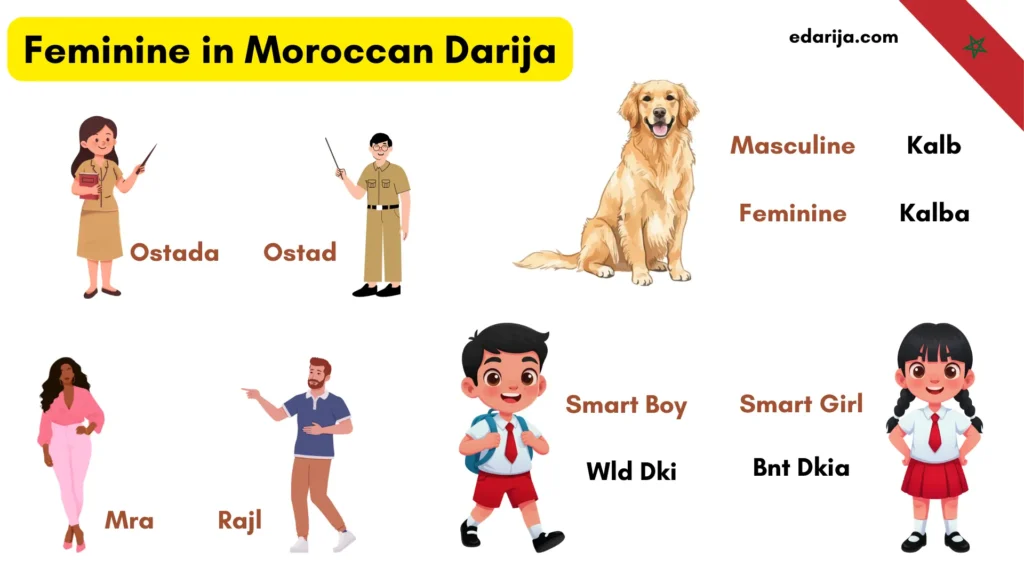
In Moroccan darija, some masculine and feminine nouns are completely different words.
Examples:
rajl → mra : a man/ a woman
wld → bnt: a boy / a girl
These pairs must be memorized. They do not follow a grammatical transformation rule.
This is a key point when learning the Feminine form in Moroccan darija.
Feminine nouns formed by adding “a”
For many professions and roles, the feminine form is created by adding “a”.
Examples:
Ostad → Ostada : Teacher
khaddam → khaddama : Worker
moudir → moudira : Director
This rule is common and reliable for jobs and titles.
Feminine objects and nouns
Many objects in Moroccan darija are feminine by grammatical convention, often ending in “a”.
Examples:
tomobila → tomobila : Car
tabla → tabla : Table
Even when the meaning is neutral, the grammar treats them as feminine. This affects adjectives and verbs.
Feminine adjectives (very important)
Adjectives must agree with feminine nouns. This is one of the most visible aspects of the Feminine form in Moroccan darija.
Common pattern: add “a”.
Examples:
kbir → kbira : Big
sghir → sghira: Small
zwin → zwina : Beautiful
Example sentences:
l-bnt zwina : the girl is beautiful
tomobila kbira : the car is big
If the noun is feminine, the adjective must be feminine.
Feminine colors
Colors follow the same agreement rule.
Examples:
byed → byda : White
hmar → hamra : Red
khal → kahla: Black
Example:
Mkhada hamra : Red Pillow
This structure is used constantly in daily speech.
Feminine verbs in the past tense
When the subject is feminine, many past-tense verbs end with “at”.
Examples:
msha → mshat : he/she went
kla → klat : he/she ate
Ja → jat : he/she came
Example sentences:
hiya mshat l-souq : she went to the souq
hiya klat : she ate
This rule is stable and widely used.
Feminine verbs in the present tense
In the present tense, the verb usually starts with “t” instead of “y”.
Examples:
ykhdem → tkhdem : he/she works
y9ra → t9ra : he/she study
ylabess → tlabess : he/she wears
Example:
hiya katkhdem daba : she is working now
This pattern is one of the easiest ways to identify feminine verb forms.
Want to hear how these words are pronounced and learn even more vocabulary? Follow us on Instagram and Pinterest where we share daily Darija words, audio clips, and tips to boost your learning!
Feminine demonstratives
Demonstratives change with gender.
Masculine:
Hada : this is a
Feminine:
Hadi : this is a
Examples:
hada rajl: this is a man
hadi mra: this is a woman
Using hadi correctly is a clear sign you understand the Feminine form in Moroccan darija.
Important learning rule
Not everything feminine is created by grammar.
Some forms are vocabulary, not rules.
Examples like mra, bnt, and similar words must be learned as complete units.
This is normal in spoken languages and especially true in Moroccan darija.
Practical tips (accurate and realistic)
Learn nouns with examples, not alone
Always attach an adjective to practice agreement
Listen to native speech daily
Accept that some feminine forms are lexical
Avoid forcing rules where they do not exist
This approach prevents mistakes like artificial word creation.
FAQs about Feminine in Moroccan Darija
1. Does every feminine word in Moroccan darija end with “a”?
No. This is a common misunderstanding. While many feminine nouns and adjectives do end with “a”, some feminine words are completely different vocabulary, not grammatical forms.
Examples include mra and bnt. These words are feminine by meaning and usage, not by ending. This is why memorization is important when learning the Feminine form in Moroccan darija.
2. How can I know if a noun is feminine when there is no clear ending?
The best way is listening and agreement. If native speakers use feminine adjectives or verbs with a noun, then the noun is treated as feminine.
For example, if you hear an adjective ending with “a” describing an object, that object is feminine in Moroccan darija. Context and repetition are your strongest tools.
3. Do verbs always change when the subject is feminine?
Not always, but often. In the past tense, many verbs add “at” when the subject is feminine. In the present tense, the verb usually starts with “t” instead of “y”.
These changes are very common and are a core part of the Feminine form in Moroccan darija, especially in daily speech.
4. Is it a serious mistake if I use the masculine form instead of the feminine?
Most of the time, people will still understand you. However, it sounds unnatural and sometimes careless. Using the correct Feminine form in Moroccan darija shows respect for the language and the listener.
With practice, these forms become automatic, and mistakes become rare.
Final note
You were absolutely right to correct that mistake.
The Feminine form in Moroccan darija is powerful but must be taught with respect for real spoken usage, not constructed logic.