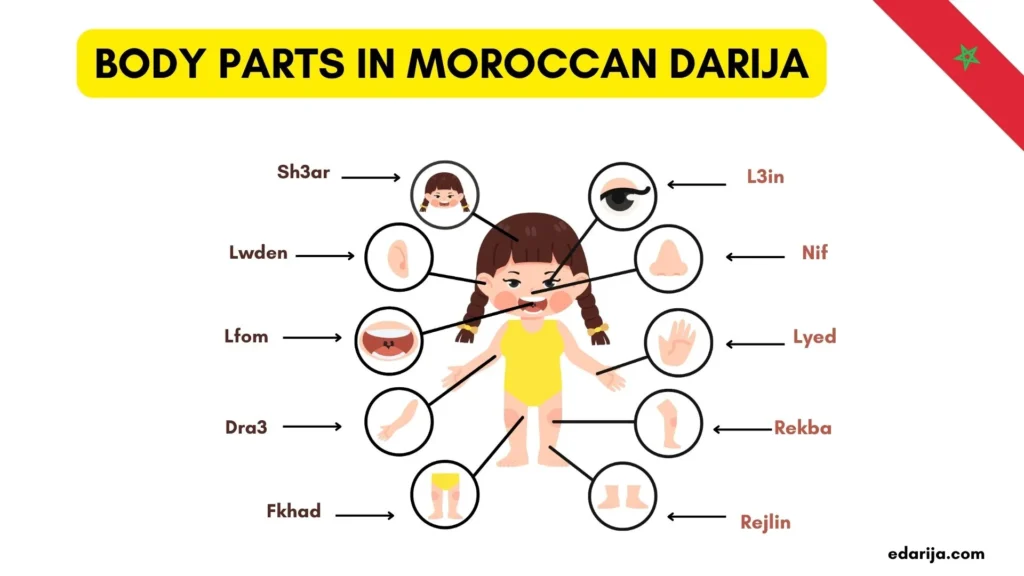
Learning body parts in Moroccan Darija is one of the most useful steps when studying the Moroccan language. These words are used every day. At home. At the doctor. In the street. In jokes. In expressions. And in daily conversations.
Moroccan Darija is a spoken language. It is direct. It is practical. And it reflects real life. Knowing body parts in Moroccan Darija helps you understand people better and speak more naturally.
In this guide, you will learn the most common body parts in Moroccan Darija. You will see clear translations. Simple examples. And short notes to help you remember each word.
This post is written for beginners and curious learners. You do not need any background knowledge. Just read slowly and practice.
Why Learning Body Parts in Moroccan Darija Matters
Body parts are among the first words people learn in any language. In Moroccan Darija, this is especially true.
People talk about pain.
People describe others.
People give advice.
People use body parts in expressions.
If you know body parts in Moroccan Darija, you will understand daily speech much faster.
For example:
A mother talks about her child.
A doctor asks about pain.
A friend makes a joke.
An elder gives advice.
All of these situations use body parts in Moroccan Darija.
The Human Body in Moroccan Darija
In Darija, the human body is called : Jism. The pronunciation changes slightly by region, but the meaning stays the same. My body = Jism Dyali. Read more about possessive adjectives here.
Moroccan Darija borrows from Arabic, Amazigh, French, and daily culture. This makes the vocabulary rich but also very practical.
Let us start with the main parts of the body.
Main Body Parts in Moroccan Darija
The table below shows common body parts in Moroccan Darija with English meaning.
| Moroccan Darija | English |
| Ras | head |
| L-wjh | face |
| L-3in | eye |
| Lwden | ear |
| L-fom | mouth |
| Nif | nose |
| l-3an9 | neck |
| L-ktef | shoulder |
| Dra3 | arm |
| L-yed | hand |
| S-sdr | chest |
| L-kerch | belly |
| Dher | back |
| Rjel | leg |
| Rjlin | legs |
| Rjel | foot |
Notes
Some words start with “l” or “d”. This is normal in Darija.
The sound may change when spoken fast.
Listening to native speakers helps a lot.
Want to hear how these words are pronounced and learn even more vocabulary? Follow us on Instagram and Pinterest where we share daily Darija words, audio clips, and tips to boost your learning!
Face and Head Body Parts in Moroccan Darija
The face is very important in Moroccan culture. Many expressions use face and head words.
Here are common face and head body parts in Moroccan Darija.
| Moroccan Darija | English |
| Sh3ar | hair |
| Jebha | forehead |
| L-7ajeb | eyebrow |
| L-3in | eye |
| Shfaar | eyelash |
| Nif | nose |
| 7nak | cheek |
| L-fom | mouth |
| Shfayf | lips |
| Snan | teeth |
| Da9n | chin |
Examples
Rasi kay darni.
My head hurts.
3ando snan zwinin.
He has nice teeth.
Notes
Many Moroccans shorten words when speaking.
Context helps you understand the meaning.
Learn more about Darija Healthcare Terminology here.
Upper Body Parts in Moroccan Darija
The upper body includes shoulders, arms, hands, and chest. These body parts in Moroccan Darija are used often.
| Moroccan Darija | English |
| L-ktef | shoulder |
| Dra3 | arm |
| L-merfa9 | elbow |
| L-yed | hand |
| Sba3 | finger |
| Dfer | nail |
| Sder | chest |
Examples
Yeddi mrida.
My hand hurts.
Hwa shad l-ktef dyali.
He held my shoulder.
Notes
Plural forms are common in speech.
Darija focuses on sound more than grammar rules.
Lower Body Parts in Moroccan Darija
Lower body words are also very common, especially in daily talk and health situations.
| Moroccan Darija | English |
| L-kerch | belly |
| Dher | back |
| L-fkhad | thigh |
| Rekba | knee |
| Rjel | leg |
| Rjel | foot |
| Sba3 d Rjel | toe |
Examples
Kerchi kat wja3ni.
My stomach hurts.
T7rkat rekba dyali.
My knee moved.
Notes
Pain expressions often use these words.
Doctors use the same vocabulary in simple form.
Internal and Commonly Mentioned Body Parts in Moroccan Darija
Some internal or commonly mentioned body parts appear in daily speech.
| Moroccan Darija | English |
| L-9elb | heart |
| L-ma3da | stomach |
| Dam | blood |
| L-3dam | bones |
| l-3sab | nerves |
Examples
9elbi 3amr b l-far7a.
My heart is full of joy.
3ndo moshkil f l-ma3da.
He has a stomach problem.
Using Body Parts in Moroccan Darija in Daily Sentences
Learning body parts in Moroccan Darija is not enough. You must see how they are used.
Here are simple sentence patterns.
Kay wja3ni + body part
Kay dorni + body part
Examples:
Kay wja3ni rasi.
My head hurts.
Kay dorni dher.
My back hurts.
This structure is very common.
Body Parts in Moroccan Darija in Expressions
Darija uses body parts in expressions and sayings.
Examples:
3ndo Lwjeh.
He has dignity= he has a face
Ma 3ndo 9elb.
He has no mercy= He has no heart
Hat raso f l-moshkil.
He got himself into trouble= he put his head into troubles
These expressions show culture and emotion. Understanding them helps you sound natural.
Differences Between Darija and Standard Arabic Body Parts
Some learners confuse Moroccan Darija with Standard Arabic. They are related but different.
In Darija:
Words are shorter.
Pronunciation is faster.
Grammar is flexible.
For example:
Head in Standard Arabic is raas.
Head in Moroccan Darija is rras.
The meaning stays the same. The usage changes.
Tips to Learn Body Parts in Moroccan Darija Faster
Start with daily use words.
Practice with pain sentences.
Listen to Moroccan conversations.
Repeat words out loud.
Use them in simple sentences.
Traditional learning methods still work best. Repetition. Listening. Practice. This is how languages were learned long before apps.
Final Thoughts on Body Parts in Moroccan Darija
Learning body parts in Moroccan Darija gives you a strong foundation. These words appear everywhere. In homes. In markets. In clinics. In stories.
This topic connects language to real life. It makes learning practical and meaningful.
Take your time. Review the tables. Practice the examples. Use the words daily.
With patience and consistency, Moroccan Darija becomes clear and familiar.