Learning a new language opens a world of new possibilities. If you have started your journey to learn Moroccan Darija for beginners online, you have probably mastered the basics of saying hello and introducing yourself. Now it is time to look forward. Literally.
One of the most exciting milestones in any language learning journey is the ability to talk about plans, dreams, and upcoming events. Today we are going to focus on exactly how to Express Future in Moroccan Darija. Unlike some European languages that require complex verb endings and table memorization, expressing the future in this dialect is surprisingly logical and straightforward.
By the end of this article, you will be able to tell your friends what you will eat tomorrow, where you will travel next year, and how you plan to practice Moroccan darija conversation with native speakers.
The Magic Word: Ghadi
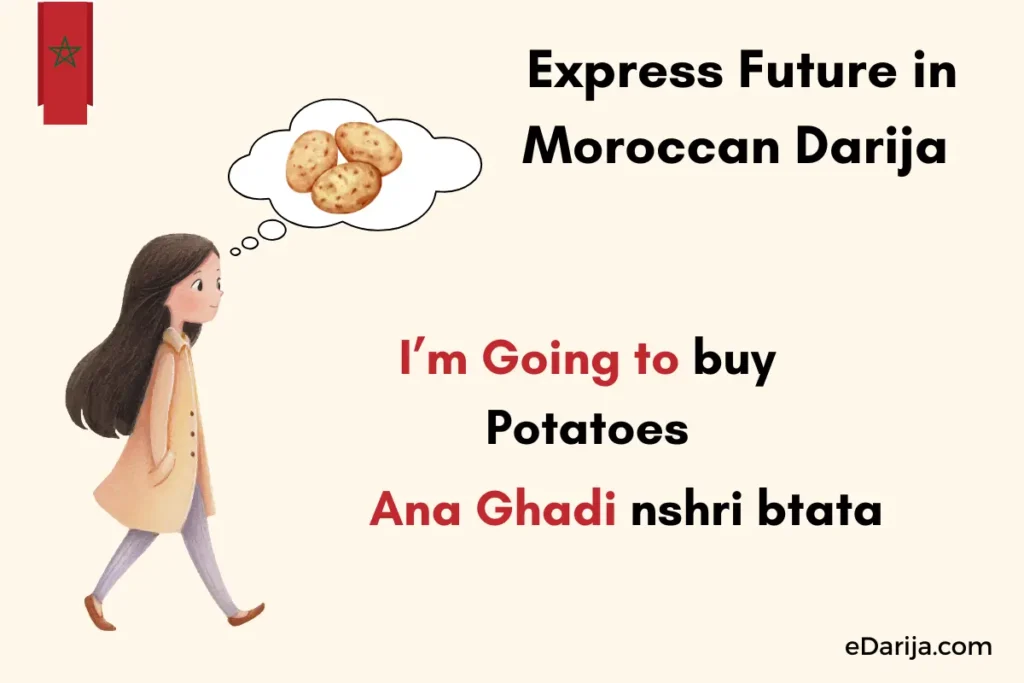
To Express Future in Moroccan Darija, you really only need to master one auxiliary word: Ghadi (often written as ghadi or radi).
Think of Ghadi as the English equivalent of “going to” or “will.” In English, you say “I am going to eat.” In Darija, the structure is almost identical. You place Ghadi before the verb.
Here is the basic formula to Express Future in Moroccan Darija:
Pronoun + Ghadi + Verb (in present tense form)
Before we dive into the verbs, let us look at how natives pronounce this magic word. In any Moroccan Arabic darija pronunciation guide, you will learn that the “Gh” is a throat sound, similar to the French “r”. However, in fast speech, many Moroccans shorten Ghadi to just Gha. Both are correct, but Ghadi is better for beginners who want to be clearly understood.
Gender and Number Agreement
Strictly speaking, because Ghadi implies “going,” it can change based on who is speaking.
- Male speaker: Ana ghadi (I am going…)
- Female speaker: Ana ghadiya (I am going…)
- Plural group: Hna ghadyin (We are going…)
However, when using it specifically to create the future tense (as a helper word), it often remains Ghadi or Gha for everyone in casual speech. This makes it much easier to speak Moroccan Arabic darija fast.
→ Check out our 100 useful Moroccan Darija Verbs
Conjugating Verbs in the Future Tense
To properly Express Future in Moroccan Darija, you need to know the present tense prefixes. In Darija, we attach a small letter to the start of the verb to indicate who is doing the action.
Let us use the verb To Drink (Shreb) as our primary example.
| Person | English | Darija |
| I | I will drink | Ana ghadi n-shreb |
| You (Masc) | You will drink | Nta ghadi t-shreb |
| You (Fem) | You will drink | Nti ghadi t-sherbi |
| He | He will drink | Huwa ghadi y-shreb |
| She | She will drink | Hiya ghadi t-shreb |
| We | We will drink | Hna ghadi n-sherbu |
| You (Plural) | You all will drink | Ntuma ghadi t-sherbu |
| They | They will drink | Huma ghadi y-sherbu |
Notice the pattern? The word ghadi stays the same. The only thing that changes is the small letter attached to the verb “shreb” (to drink” . This pattern applies to almost every verb when you want to Express Future in Moroccan Darija.
Common Verbs to Practice
A good Moroccan Arabic darija phrasebook for travelers will list essential verbs. Here are the top verbs you need to know, conjugated in the first person (“I will…”) to help you practice.
1. To Go (Msha)
- Future: I will go.
- Darija: Ana ghadi n-mshi.
- Short form: Ana gha n-mshi.
2. To Eat (Kla)
- Future: I will eat.
- Darija: Ana ghadi n-akul.
- Short form: Ana gha n-akul.
3. To Sleep (N3as)
- Future: I will sleep.
- Darija: Ana ghadi n-n3as.
- Short form: Ana gha n-n3as.
4. To Travel (Safer)
- Future: I will travel.
- Darija: Ana ghadi n-safer.
- Short form: Ana gha n-safer.
5. To Work (Khdem)
- Future: I will work.
- Darija: Ana ghadi n-khdem.
- Short form: Ana gha n-khdem.
If you are taking a Moroccan darija grammar course for non native speakers, you will notice that consistency is key. Once you learn the “n-” prefix for “I”, you can apply it to almost any action.
Want to hear how these words are pronounced and learn even more vocabulary? Follow us on Instagram and Pinterest where we share daily Darija words, audio clips, and tips to boost your learning!
Time Markers for the Future
To fully Express Future in Moroccan Darija, you need to know when things are happening. You cannot just say “I will go” without context. Context is king in Moroccan Arabic darija vocabulary lessons.
Here are the most important time words:
- Tomorrow: Ghedda
- After tomorrow: Be3d ghedda
- Tonight: Lyoum fel-lil (Literally: Today in the night)
- Next week: Simana lmajya
- Next month: Sh’her lmaji
- Next year: L3am lmaji
- Later / Afterward: Men be3d
- Soon: Qrib
Example Sentences:
- I will travel to Marrakech next week.
- Ana ghadi n-safer l-Marrakech simana l-majya.
- We will eat couscous tomorrow.
- Hna ghadi n-aklou l-kseksu ghedda.
- She will study Arabic next year.
- Hiya ghadi t-qra l3arbiya l3am lmaji.
The Negative Future
What if you want to say you will not do something? This is a crucial part of any Moroccan Arabic darija tutoring online session.
To make the future negative, we use the particles ma…sh. Usually, we place ma before ghadi and sh at the end of the verb phrase, or sometimes just attach the negative to ghadi.
Option A (Easier for beginners):
- Structure: Ma ghadi-sh + Verb
- English: I will not go.
- Darija: Ma ghadi-sh n-mshi.
Option B (Native speed):
- Structure: Ma gha-n-mshi-sh.
- English: I won’t go.
- Darija: Ma gha-n-mshi-sh.
Let’s stick to Option A as you start to Express Future in Moroccan Darija. It is clearer and understood by everyone.
- I will not eat meat. = Ma ghadi-sh n-akul l-l7am.
- He will not sleep here. = Huwa ma ghadi-sh y-n3as hna.
How to Ask Questions about the Future
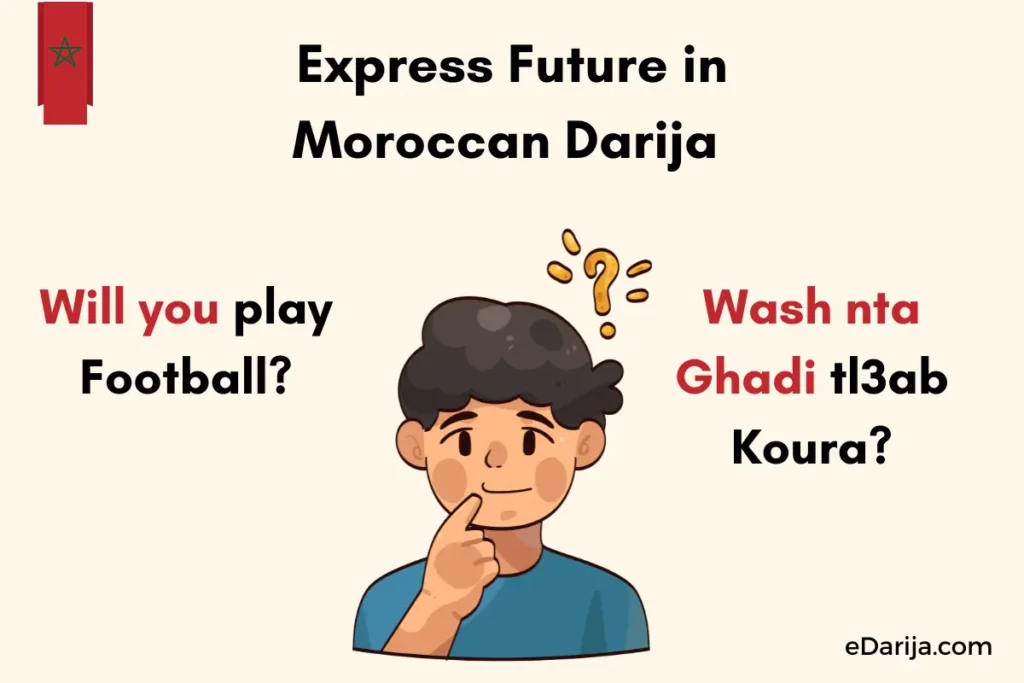
A Moroccan Arabic darija phrasebook for travelers is not complete without questions. Asking “Will you…?” is very simple. You just use the same structure as the statement, but you change your intonation (raise your voice at the end).
- Statement: Nta ghadi t-safer. (You will travel.)
- Question: Wash nta ghadi t-safer? (Are you going to travel?)
Adding the word Wash (Is/Do/Will) at the start makes it a clear question.
- Will you help me? = Wash ghadi t-3awenni?
- When will you come? = Fuqash ghadi t-ji?
- Where will we go? = Fin ghadi n-mshiw?
→ Have a look at our complete beginner’s guide to essential question phrases.
Practical Exercises
To truly master how to Express Future in Moroccan Darija, you need to put it into practice. Reading is passive, but speaking is active. Here is a short dialogue to help you visualize a conversation.
Dialogue: Planning the Weekend
Karim: Salam Sara! Ash ghadi diri ghedda? (Hello Sara! What will you do tomorrow?)
Sara: Salam Karim. Ana ghadi n-mshi l-suq m3a mama. (Hello Karim. I will go to the market with my mom.)
Karim: Mezyan. Wash ghadi t-sherbi qahwa men be3d? (Good. Will you drink coffee afterwards?)
Sara: Iyeh, hna ghadi n-gelso f-cafe “zohour” Nta ash ghadi dir? (Yes, we will sit at cafe “zohour” What will you do?)
Karim: Ana ghadi n-l3ab l-kura m3a drari. (I will play football with the guys.)
Analyzing this dialogue helps reinforce the best apps to learn darija Moroccan dialect, which often use similar script-based learning. Notice how often they Express Future in Moroccan Darija using the simple “Ghadi + n/t prefix” formula.
Tips for Learning Fast
If your goal is to learn how to speak Moroccan Arabic darija fast, do not get hung up on perfection. Here are three tips:
- Shorten it: Start using “Gha” instead of “Ghadi” once you are comfortable. “Ana gha n-shuf” (I will see) sounds much more local than “Ana ghadi n-shuf.”
- Don’t worry about gender: If you mix up “Ghadi” and “Ghadiya,” people will still understand you perfectly. The verb conjugation (n-mshi, t-mshi) is more important.
- Immerse yourself: Look for free resources to learn Moroccan Darija on YouTube. Listen to how they pronounce the future tense. You will hear that “Gha” sound constantly.
The future tense is one of the most liberating parts of grammar. It takes you from describing what is happening now to sharing your vision of what is to come. Whether you are using a Moroccan Arabic darija phrasebook for travelers or taking deep-dive Moroccan Arabic darija vocabulary lessons, remember that the key is “Ghadi.”
Master this one word, and you unlock the ability to Express Future in Moroccan Darija with confidence. So, asking you now: Ash ghadi dir ghedda? (What will you do tomorrow?)
Go out there and practice!
FAQs on How To Express Future in Moroccan Darija
1. How do I say “I will” in Moroccan Darija?
To say “I will,” you use the word Ghadi followed by the verb starting with “n” (for “I”). For example, “I will go” is “Ana ghadi n-mshi.” This is the most reliable way to Express Future in Moroccan Darija.
2. Is it better to use “Ghadi” or “Gha”?
Both are correct. “Ghadi” is the formal, full version and is excellent for students. “Gha” is the shortened version locals use to speak Moroccan Arabic darija fast. We recommend beginners start with “Ghadi” until they are comfortable with the flow.
3. Do verb endings change in the future tense in Darija?
No, unlike many European languages, the verb endings do not change based on tense complexity. You simply keep the present tense prefixes and add “Ghadi” in front. This simplicity makes it easier to learn Moroccan Darija for beginners online.
4. Where can I find free lessons for Darija?
There are many free resources to learn Moroccan Darija available today, including YouTube channels, language exchange apps, and community forums. Combining these with a Moroccan Arabic darija phrasebook for travelers will speed up your learning process.